As the weather gets colder, it’s more and more enticing to lean into cozying up at home. Here are our favorite sustainable and local brands and ideas for the homebodies!
Read more2025 Holiday Gift Guide: For the Homebody
As the weather gets colder, it’s more and more enticing to lean into cozying up at home. Here are our favorite sustainable and local brands and ideas for the homebodies!
Read more2025 Holiday Gift Guide: For the Outdoor Lover
For our fellow outdoor lovers, we know that the most meaningful gifts are those that are as kind to the planet as they are essential for the trail. We’ve compiled a list of ethically sourced items, local shops, and memorable access experiences to source everything your favorite adventurer might need.
Read more2025 Holiday Gift Guide: Local Shopping Opportunities
Shopping local this holiday season isn’t just good for Minnesota’s economy, it supports the planet, too. When you buy from nearby makers and shops, your gifts travel fewer miles, meaning fewer emissions and less shipping waste. Plus, supporting local helps our neighbors and keeps our communities thriving. This year, skip the shipping truck and give the planet (and your neighbors) something to celebrate!
Read moreSolar Behind the Scenes: Insights from Greenway Solar

Greenway Solar is a full service contractor for Midwesteners to switch to solar, providing farms, businesses, and homes with the opportunity to cut energy costs and support sustainable energy use. We spoke with founder Paul Krumrich to better understand their mission and journey in the renewable energy space.
Native Sustainability: Could you give us a little background on what inspired you to start Greenway Solar?
Paul Krumrich: Greenway Solar started when we were asked to help with creating a solar garden for low-income folks in the area. Specifically, Minnesota Renewable Energy Society requested that we work on three solar gardens in low-income communities. That experience was really inspiring for us– we realized this is something we can do to help people, and something that we want to do and care about.
NS: That’s awesome. Something that differentiates Greenway is that you’re the only provider in Minnesota to use the Tesla solar roof as well as offering traditional panels. What’s the difference between these options?
PK: The solar roof is a bigger commitment – it’s a total replacement of the roof, whereas the panels are a lighter project because they can be added to an existing roof. The solar roof is more difficult to calculate a return on investment for because costs are slightly different based on each project, so the roofs are more of a premium product in terms of out of pocket spending.
But then you have an entire durable structure that will last you 50 years – it’s really a slick innovation.
NS: Can you share a story or example of a particularly inspiring project with Greenway?
PK: Absolutely, we’ve gotten to engage in lots of projects that have been really cool and inspiring. One that sticks out to me was when we did an off-grid Tesla project up north in a cabin with no electricity. We used powerwalls for that and it was a successful run.
In general we’re hoping to get the point across that you don’t have to live in a fancy house for solar to be something that could be useful for you. It is a premium product, but we can install on lots of types of houses and buildings, not just big buildings in wealthier areas.
NS: What are some of the challenges your team has faced in the solar industry?
PK: The regulation and interconnection processes have been challenging. Different cities and states have different regulations for different utilities… it’s a lot to juggle.
It’s also difficult to get systems online, that’s something that’s taken effort on our end. But as far as clients go, people have really been great – no major challenges there.
NS: How do you see your company’s role in driving forward the renewable energy movement, and what message do you hope to convey to potential customers and the public?
PK: Our specific approach sets us apart. There are lots of companies out there that are totally oriented in maxing out their number of sales, which can lead them to put high pressure on customers to make decisions fast and rush the process.
We’re a lot more detail-oriented. We care about the design and aesthetic of our installations, and we’re local. We aren’t pushy – we have a goal of maintaining a 25 year relationship with each client, we don’t just treat them as a quick sale. Our work is more consultative, rather than trying to get people to sign on fast. We get positive feedback about that all the time– it’s an aspect that’s hard to convey in something like ads, but customers get it after a while.
NS: As the solar industry continues to evolve, do you anticipate any major changes in the future to your operations or expect any trends to arise?
I think we’ll definitely get more to covering battery and storage. Our industry is in a continued evolution. Five years ago we focused on just solar energy, now there’s a major shift to working with batteries or control systems as well. More electric vehicle chargers for cars will be needed as well. In general, the shift seems to be transitioning from solar power into broader energy management.
Many thanks to Paul for these insights! Learn more about Greenway Solar here.
Earth Day 2020: 50th Anniversary
This year marks the 50th anniversary of Earth Day! Though the world is practicing social distancing amidst the Coronavirus crisis, there are still ways to recognize and celebrate this important day. Join us in a way that works for you, and help us to carry this advocacy momentum throughout the whole year!

photo courtesy of NASA
History of Earth Day
The first Earth Day occurred on April 22, 1970, “putting environmental concerns on the front page.” Though many events led up to it, Earth Day was largely inspired by the student anti-war movement, an emerging public consciousness about air and water pollution, and the political climate. With growing smog in the air, rivers catching on fire, and increasing oil spills, it was clear that the environment was in crisis. 20 million Americans participated in demonstrations, marches, and rallies on this first Earth Day. Colleges and universities were a huge part of this action. Americans truly came together in the name of the planet.
Since 1970, the annual Earth Day celebrations have grown. Nearly every city in the US participates in some way, driven by passionate non-profits, environmental organizations, students, teachers, and individuals. With 10% of the US population, this first Earth day is still recognized as the largest organized public event in the world’s history.
Below are some ways to get involved with Earth Day 2020!
LOCAL / VIRTUAL
Climate Generation: A Will Steger Legacy
Eyewitness: Earth Day Storytelling Slam
City of Roseville
Earth Day Online Celebration
Interfaith Power and Light
Film: The Human Element
Arrowhead Earth Week
50 Ideas For Earth Day
LOCAL / OUTDOORS
Head out to your local park or outdoor area with a bag and some gloves for a #wastewalk! Springtime is a great opportunity to get out and clean up the litter and debris that’s been hidden under our Minnesota snow all winter. Share a photo of your socially distant cleanup* with the hashtag #wastewalk and tag us!

Anika and Isla #wastewalk at Lake Harriet

Megan’s #wastewalk haul
Local Parks
Theodore Wirth
Hyland Lake Park Reserve
Murphy-Hanrehan Park Reserve
Spring Lake Regional Park
Baker Park Reserve
Carver Park Reserve
French Regional Park
North Mississippi River Regional Park
State Parks
Fort Snelling State Park
Afton State Park
Nerstrand Big Woods State Park
Frontenac State Park
Minnesota Valley State Park
William O’Brien State Park
Greenleaf Lake State Park
*Please #wastewalk responsibly. If a park seems too crowded to safely practice social distancing, please find a different outdoor area.
NATIONAL
Earth Day Initiative
This year, Earth Day Initiative is launching the Together We Can: Climate Action Campaign designed to get everyone to make at least one important commitment to reduce their climate impact for the 50th anniversary of Earth Day. Follow on instagram @earthdayinitiative to hear from leaders including Elizabeth Warren, Ian Somerhalder, Bill Nye, Joseph Gordon-Levitt, and more.
NASA
NASA has collected activities, videos, special programs and other materials to help you observe “Earth Day at Home,” including videos, online games and mobile apps, social media events, and even Lego activities for #EarthDayAtHome.
Earth Day Network
Over the 24 hours of Earth Day, the 50th anniversary of Earth Day will fill the digital landscape with global conversations, calls to action, performances, and video teach-ins from guests Zac Efron, Al Gore, Dr. Sylvia Earle, John Kerry, Zdeno Chara, Paul Nicklen, and more.
Tune in to their Instagram live (@earthdaynetwork) on April 22 and download their app for even more Earth Day engagement!

Art by @ashlukadraws
Pattie Gonia
Environmentalist-drag-queen Pattie Gonia is taking the world by storm (no pun intended), shedding necessary light on the environmental crisis. Pattie (she/her), the fabulous alter ego of Wyn Wiley (he/him), uses visual imagery, poetry and songwriting, and community involvement to generate action to save the planet. What began as an instagram account for fun has now evolved into hundreds of thousands of followers and short films produced by REI.

instagram.com/pattiegonia
Wiley states “Pattie is synonymous in my life with learning and unlearning...I have so much left to learn.” This sentiment rings so true. As a society, we are ingrained in our habits. We all have lessons to learn and unlearn. Wyn hopes that the messages he puts out through film and photograph “can open people’s minds.”
Most notably, Pattie’s powerful youtube videos use her voice not just for “allyship for mother nature” but also as a tool for social justice. These videos are about speaking in truth, appreciating our collective impact, and embracing what makes us all different. Through these sentiments, they inspire us to act for the earth.
We at Native Sustainability fully believe that we are in a climate crisis. We love seeing any and all efforts to highlight environmental issues and develop solutions. We must act on this crisis!
“Everything To Lose” by Pattie Gonia
"Everything to Lose"
by Pattie Gonia
Welcome to the planet, my dears
Wipe your feet, come on in
No more need for coats in your mother’s den
Take a look around
Take a taste of the waste we’ve found
This … is plastic
And this ... is tragic
And it’s not going away
So let us sit
At the dinner table in the home we call nature
Come, let’s chat, I have an ice breaker
Are we still lighting candles while the house is burning?
While we throw flame and fight over who is right
our Mother does not bite her tongue or sit in silence
Oh no, Mother Natch is pissed
You see, a woman knows when she’s been told
When the men in the boardroom think she’s being too bold
Too proud, too outspoken, too much to handle
When she’s been made the doormat instead of the mantle
Is this our message in a plastic bottle?
XO hugs kisses
I’ll try better tomorrow
Day after day we send our regards
Millions and millions of plastic discards
P.S. We don’t give a damn.
But we should really give a damn.
Now I know what you’re saying, “It’s just a drop in the bucket”
“It’s just one plastic bag, one straw, so suck it”
Well suck. On. This.
Right now, there are more plastic pieces in the ocean
Than stars in the Milky Way
A billion plastic bags being used every single day
While we dress this mess in political gains and power change and profits made
Our mother says to go upstairs and put on something new
So come out of the closet and put on your boots
We’ve got a s**t ton of work to do.
So queens, let me be straight
Father Time is ticking on
And what will be left is what we have done
Our mother is dying while we are out living
We must turn the tide from taking to giving
We will make a difference if we dare choose
It’s time that we act …
We’ve got everything to lose.
(TICKING OF CLOCK)
Credits:
Starring/Directing - Pattie Gonia, Wyn Wiley
Production Company - Wondercamp
Director/Editor - Tim Kressin
Producer - Davis Goslin
Assistant Producer - Jenny Dugan
Manager - Dayna Turnblom
Sustainable Designer - Angela Luna, ADIFF
Hair & Makeup - Katie Nash
Find Wyn/Pattie on REI’s Youtube channel and on Instagram: @pattiegonia
“Dear Mother Nature” by Pattie Gonia
Recycling Right

Artist: Greta Kaul
Read up on this MinnPost article describing best practices for recycling in Minnesota! The recycling system relies on us, consumers, to make our best effort to properly recycle.
Some Key Takeaways:
WISHCYCLING - tossing something into the recycling bin that actually isn’t recyclable (but we wish it was) - is one of the most important practices to AVOID. By eliminating non-recyclable materials from recycling facilities, it will make the jobs of those sorting our waste much easier, as well as prevent potential damage to machinery.
Food, beverage, laundry and bathroom containers are recyclable in general, except those labeled #6, or that are black in color. Black plastics are too hard for machines to sort, so recyclers are no longer accepting them.
Papers and cardboards are generally recyclable if they haven’t touched food.
Food containers, like those for yogurt, peanut butter or spaghetti sauce should be pretty well cleaned out, but it doesn’t have to be perfect - 95 percent is good! This is mostly because humans have to do some of the sorting and that food gets gross.
It’s actually better if your recycling is loose, not in grocery bags. That’s because recycling trucks compact the contents of your bin, and they can be hard for machines – or even people — to pull back apart if they’ve been squished together inside paper bags.
Courtesy of Kare 11
MealConnect

Source: https://mealconnect.org/
Feeding America
Feeding America is the nation’s largest domestic hunger-relief organization. Their mission is to feed America’s hungry through a nationwide network of member food banks, and engage our country in the fight to end hunger. It is estimated that 72 billion pounds of food go to waste each year, entering the landfill instead of ending up on the plates of those who need it. The Feeding America network works with manufacturers, distributors, retailers, food service companies and farmers to gather food and transport it to food banks before it goes to waste.

MealConnect Process
Source: https://mealconnect.org/
Technology For Good
To source more meals and help end hunger in America, Feeding America has created MealConnect™, a technology platform that makes it easier than ever to connect donors with surplus food to their local Feeding America member food banks and their partners. MealConnect gives food donors a convenient, free and safe way to reduce waste & connect surplus meals with food insecure neighbors.
Using a simple app, food businesses can access an easy way to donate any leftover food that may go to waste. The MealConnect team is able to accommodate food donations from large retailers to small family-owned restaurants, and most places in between. Other benefits include donation guidelines, the ability to track donations, a tax benefit calculator, and an easy, sustainable partnership. Oh, and it’s completely free! Donating excess food has never been easier.
Feeding America is launching a new component of MealConnect that will empower food donors and revolutionize local food rescue. Through a new web-based donor portal, food donors such as restaurants, grocery stores or cafes can post excess food available to donate.
Earth Day Recap

Anika and Megan at the cleanup
Yesterday was an important one. Earth Day! For the past 49 years, we have recognized this day as one of climate action. And while we focus on our sustainable practices on this day each year, it’s important that we continue this momentum for the other 364 days of the year.
This past Saturday, Native Sustainability hosted an Earth Day cleanup at the Minnehaha Falls Off-Leash Dog Park. With about 20 incredible volunteers, and pups surrounding us, we dispersed into this beautiful dog park to collect as much trash and recyclables as we could in two and a half hours. Below, Edie poses with our collected waste - about 10 bags in total! The waste included everything from plastic bags and aluminum cans to ceramic dishes and abandoned toys. The most profound part of this was that at first glance, the Minnehaha dog park appeared relatively garbage-free as we walked in. Witnessing this much waste collected from a seemingly clean park put a lot in perspective for us all.

Edie with our trash haul
Our cleanup was a branch of the larger city-wide Earth Day cleanups happening all over Minneapolis. Organized by the Minneapolis Parks Foundation, groups of volunteers spent the day cleaning up outdoors.

Drop site for the Earth Day Cleanups at Minnehaha Falls

Standing on trash :(
Here are some key takeaways from our cleanup:
Plastic comes in many forms. It is all around us. And it won’t be going away during our lifetime. Plastic particles, large and small, comprised the majority of the waste we collected on Saturday.
Litter can show up everywhere, but certain areas tend to have more accumulation than others. Areas we noticed significantly more litter included:
Low-lying areas where gravity and water flow can wash particles down into. Being located along the Mississippi River, this particular dog park contains bluffs and ridges with deep gullies and ravines. We found large amounts of trash down in these lower areas.
Along the bases of fence lines: Fences catch pieces of waste blowing in the wind. In just 10 minutes we filled an entire trash bag with waste along the outer fence of the dog park!
Off of maintained trails. Chances are, most of the trash along these frequently walked paths get picked up more often than that in less visible areas. But just because it’s not easily seen doesn’t mean it’s not there!
Waste lasts a long. Time. Adjacent to the dog park is an area of land that was formerly a dump site. We found the remains of decades-old trash around this dumpsite, so much that we could have been there for days picking it all up. It is so critical for us to think about the full life of material items we consume. Do we really need it? How can we most responsible dispose of it when we no longer need it? Is there an alternative that might be compostable or reusable?
You never know what you’ll find! Our most interesting find of the day was a mallet which Megan took home to add to her toolbox. Cleaning up always pays off one way or another.

Megan’s Mallet
Happy Earth Day EVERYDAY!
April 22 is Earth Day!

Edie at the Minnehaha Falls Dog Park
This year marks the 49th annual celebration of this recognition, valuable not only for the honor it gives to our planet, but also the action it encourages and the rich history it holds. Earth Day may be one out of 365 days each year, but it represents so much more than that.

In 1962, Biologist and writer Rachel Carson published Silent Spring, an expose on the harmful effects of pollution and pesticides on the environment as well as human health. Silent Spring quickly became a New York Times bestseller, selling over 500,000 copies. Fast forward 8 years later, and the growing anti-war movement fed energy into this newfound environmental movement. On April 22, 1970, the very first Earth Day “gave voice to that emerging consciousness...putting environmental concerns on the front page.”
Then-Wisconsin Senator Gaylord Nelson came up with the idea for a national day of focus on the environment “after witnessing the ravages of the 1969 massive oil spill in Santa Barbara, California. Inspired by the student anti-war movement, he realized that if he could infuse that energy with an emerging public consciousness about air and water pollution, it would force environmental protection onto the national political agenda. Senator Nelson announced the idea for a ‘national teach-in on the environment’ to the national media; persuaded Pete McCloskey, a conservation-minded Republican Congressman, to serve as his co-chair; and recruited Denis Hayes from Harvard as national coordinator. Hayes built a national staff of 85 to promote events across the land. April 22, falling between Spring Break and Final Exams, was selected as the date.”
Original broadcast of CBS News Special Report with Walter Cronkite about the first Earth Day, 1970. Also known as Earth Week 1970.
The Earth Day celebration happened all across the US; 20 million Americans participated in demonstrations, marches, and rallies. Colleges and universities were a huge part of this action. Americans truly came together in the name of the planet.
Since 1970, the annual Earth Day celebrations have grown. Nearly every city in the US participates in some way, driven by passionate non-profits, environmental organizations, students, teachers, and individuals.
This year, Native Sustainability will host its own Earth Day Cleanup at the Minnehaha Falls Off-Leash Dog Park! For us, this day is about gathering together to focus on the health of the planet and the animals living on it, including humans. By doing this, we seek to build momentum in our community to continue environmental action throughout the rest of the year.
Join us for our dog park cleanup!*
Saturday, April 20
9:30am-12:00pm
5399 Minnehaha Park Dr S, Minneapolis, MN 55417
*Dog ownership is not necessary for humans to attend! All are welcome, including dogs if you own them. We will meet by the entrance of the dog park and will provide gloves and bags.
RSVP: https://www.eventbrite.com/e/earth-day-dog-park-cleanup-tickets-58722613919
Source: earthday.org
Imperfect Produce
This month, a beautiful thing happened. Imperfect Produce made their way to the Twin Cities. Founded in 2015, Imperfect rescues “ugly” or unmarketable produce from local farmers and grocery stores within each respective city in which they have become established. Their model gives a chance for farmers to be compensated for EVERYTHING they grow, not just the “nice” looking stuff. Resulting from this is a reduction in food waste. The cherry on top is that Imperfect also partners with nonprofits and food banks, addressing hunger as well. We think this is a win-win-win!
When co-founders Ben Simon and Ben Chesler launched Imperfect on August 8th, 2015, they had a vision of building a more sustainable and effective food system to better our communities and the environment. Since launch in 2015, Imperfect has recovered 40 million pounds of produce. In 2018 alone, Imperfect rescued 32 million pounds of produce and is projected to rescue 50 million pounds in 2019. They have donated over 2.1 million pounds of produce to over 70 nonprofit partners and food banks. In addition to rescuing food, Imperfect has saved 1.2 billion gallons of water, and 110 million pounds of carbon dioxide.
Food waste has reached extreme levels across the globe. Inextricably linked with the global hunger epidemic, it’s on all of us to address the issue. What we choose to consume, how we consume it, and how much of it we waste has plaguing ripple effects on the environment, economics, and people.
Food Waste By The Numbers:
-40% of all the food produced in the US goes uneaten. (Feeding America)
-20 billion pounds of produce from farms is unharvested or unsold each year. (Feeding America)
-For every 1 pound of farm level surplus recovered by food banks, there are still about 25 pounds of perfectly nutritious produce going to animal feed, compost, landfill, or being left in the fields. (Feeding America)
-Feeding America received 1.47 billion pounds of produce in 2017. Of that amount, roughly 10% of it comes from farms, leaving 20 billion pounds still wasted each year on farms. (Feeding America)
-Every year, 1.4 billion tons of food—a third of global production—ends up in landfills. By some estimates, this adds up to nearly $1 trillion of annual squander and the production of about 8% of all human-caused greenhouse gases. At the same time, nearly 800 million people go hungry every day. (ReFED)
-The U.S. wastes 63 million tons of food each year, for which farms make up 16%. The main offenders are individuals, contributing to about 43% of all the waste. (ReFED)
-30% of food is wasted globally across the supply chain, contributing 8% of total global greenhouse gas emissions. If food waste were a country, it would come in third after the United States and China in terms of impact on global warming. (U.N. Food and Agriculture Organization)
-Fruits and vegetables, plus roots and tubers have the highest wastage rates of any food. (U.N. Food and Agriculture Organization)
-Globally, 30% of food waste and loss comes from grains and 40-50% of food waste and loss comes from root crops, fruits and vegetables. (U.N. Food and Agriculture Organization)
-Every year, consumers in rich countries waste almost as much food (222 million tons) as the entire net food production of sub-Saharan Africa (230 million tons). (U.N. Food and Agriculture Organization)
We received our first box of imperfect produce this week. We chose the “small organic box” for our first order; as a customer, you have the choice each week between four box types: Organic, All Fruit, All Veggie, or Mixed Fruit and Veggie. Each type has size options of small, medium, large, or extra large, and can be delivered weekly or every other week. Check out the contents of our first small organic box:

Our box included: 5 large rainbow carrots, a package of shishito peppers, 3 apples, 4 mandarins, 7 roma tomatoes, and 3 zucchini.
Cost Analysis
Imperfect’s Pricing Structure gives a price range for each box type and size, depending on how one chooses to customize their box. Ours ended up costing about $16, and we opted out of customizing our first box in order to see how much food would automatically be included in it.

Source: Imperfect Produce
Our price breakdown for estimated average grocery store prices of the veggies we got:
5 large organic carrots = $2
1 package organic shishito peppers = $2
3 organic apples = $2
4 organic mandarins = $2
7 organic roma tomatoes = $4
3 organic zucchini = $2
ESTIMATED TOTAL = $14
The amount of produce in our box, compared its estimated cost to what we actually paid, seemed to be slightly higher than what we would have expected. HOWEVER! When taking into account that this organic produce was delivered to our doorstep in addition to the benefits of reducing waste and financially supporting local farmers, a couple dollars extra seems completely worth it

Source: Imperfect Produce
Imperfect’s website is very user friendly. Each week, an email reminder is sent to customers letting them know when it’s time to customize their next box. The user profile page shows when your next box is scheduled to arrive. Another impressive feature of their website is the impact indicator, which shows you statistics about the impact of your purchases:

Source: Imperfect Produce
Of course, all of this fresh produce called for a day of cooking during this week’s blizzard in Minnesota. Anika made a pan full of roast veggies, zucchini banana bread, and blistered shishito peppers with sea salt. These peppers are very mild and slightly sweet. However, it is said that about 1 out of every 12 peppers is surprisingly hot!

Blistered shishito peppers in olive oil and sea salt
Anika’s recipe:
1 package shishito peppers
3 tbsp olive oil
A few pinches of Sea salt
Heat olive oil in a pan on low-medium heat (cast iron works best but we used a regular non-stick pan)
Add peppers, toss until they’re coated in oil.
Continue tossing intermittently until peppers begin blistering.
Sprinkle with sea salt and toss again.
Peppers are done when blistered to your liking! (5-15 mins)
Devour whole (except stem) or chop up and add to other dishes.
All in all, we give imperfect 5 stars for produce content, dedication to their mission, and all of the benefits that come from it! We are sold!
Use our code, “nativesustainability” for 50% off your first box!

Contents of the small organic box
Imperfect is available in 18 markets across the United States, including:
Austin, TX
Baltimore, MD
Bay Area, CA
Chicago, IL
Dallas/Fort Worth, TX
Greater Sacramento Area, CA (including Davis)
Houston, TX
Indianapolis, IN
Los Angeles, CA
Milwaukee, WI
Montgomery County, MD
Northern Virginia, VA
Orange County, CA
Portland, OR
San Antonio, TX
San Diego, CA
Seattle, WA Metro Area (including Tacoma and Olympia)
Washington, D.C.
Minneapolis/St. Paul, MN
Natural problem-solving
This week, Megan had the opportunity to make a new friend at the Solid Waste Operator Conference co-hosted by the Air & Waste Management Association and SWANA - the Solid Waste Association of North America’s Land of Lakes Chapter. Meet Emma, a beautiful Harris Hawk with quite the resume.

Megan and Emma
Emma is just one of many predatory birds employed by Predator Birds Services Inc. (PBSI), a company with a mission to solve pest problems in the most “natural” way possible - using nature itself. PBSI trains predatory birds to sustainably manage pests in settings such as landfills, airports, and more. Essentially, the predators create hostile environments for smaller nuisance birds such as Starlings, Gulls, Turkey Vulchers, etc. in order to deter these species from invading these environments.

Jackie and Emma
The idea is simple - channeling ecological hierarchies that have been in place since before humans were even around - and yet seemingly innovative. Jackie, Emma’s handler, described the creative ways in which this system works, exemplifying how there truly is a job for everything.
Native strives to follow this model of sustainability in our work as well. Biomimicry - the design and production of materials, structures, and systems that are modeled on biological entities and processes- reinforces this idea; proving that nature has successfully fine-tuned methods of solving problems. If we pay attention to these methods, we have a better chance to create sustainable solutions in our complex world.
Click here to find out more about the birds and services of PBSI.
Taste The Waste
Calling all foodies and hunger fighters: Taste The Waste!
Interested in ways to learn more about solutions to the food waste? Need a break from cooking this week? If you answered yes to either of these questions, then mark your calendar for Taste The Waste, an interactive food waste awareness event this Thursday night, February 7th at the Red Stag Supperclub. The dinner will feature a series of small plate dishes created from recovered food, thanks to Twin Cities Coop Partners. Each ticket will also include a beer from Finnegans, a brewery dedicated to “turning beer into food” through local partnerships with farmers and hunger relief organizations.

Click to visit the Eventbrite registration page
The issue of wasted food has exploded to epidemic proportions, especially here in the United States. According to the Natural Resource Defense Council’s “Save The Food” initiative, 40% of food in the United States goes to waste, getting tossed instead of being consumed. Aggregated from not only restaurants and grocery stores, but from individual households, we all have a part in this wasted food. Not only does food waste result in tremendous environmental and social consequences, but there are also financial repercussions. Save The Food has calculated that a 4-person family can lose at least $1500 a year on food that gets tossed in the home!
The environmental impacts of wasted food are extensive; from the farming production resources expended, to processing and packaging, transportation, consumption, and finally to waste management; all food has a story. When food is thrown away, it is not only a waste of that physical item, but also of water, soil, fossil fuels, and human labor. For instance, Save The Food estimates that 1 pound of beef utilizes approximately the same amount of water as it takes to shower for 370 minutes. If that beef is never eaten, that is a lot of wasted resources.
While 40% of food is going straight into the landfill, 40 million Americans are fighting hunger (Feeding America). Food insecurity issues surround us here in Minnesota, where 1 in 11 households are affected. Many local organizations, including food banks and shelves, farmers, restaurant partners, and more are working to solve this disconnect and improve these intertwined issues.
Consider attending Taste The Waste or getting involved in some other way!
Register Here: Taste The Waste
Sources:
Progress.
It’s an exciting time at Little Six Casino - the smaller casino next to Mystic Lake Hotel & Casino. We’ve launched a pilot to test a new compostable cup (say goodbye to the styrofoam!) as well as new collection containers on the casino floor, which adds traditional recycling, as well as organics recycling in the front-of-house. The new bins are labeled with Recycle Across America standardized signage, to make sure we’re doing everything possible to clean up the stream. Should all go well at Little Six, the hope is to convert all of Mystic’s front of house operations in 2019. We anticipate big diversion rates with this project! More to come.

New waste collection bins at Little Six Casino, featuring Recycle Across America standardized signs.
Digging In
An audit of a trash bag from a large volume restaurant
Read moreRewire - Super Bowl LII: The New Recycling Solution
https://www.rewire.org/video/the-super-bowls-recycling-solution/ China used to buy about half of the recycled materials on the planet, according to the New York Times. Now, China has closed its borders to those recyclables because contamination levels have been so high. This isn't a new problem though-contamination has plagued the recycling industry for years.
I was honored to be a part of this story put together by Rewire of the state of recycling, and the efforts at Super Bowl LII in Minneapolis. It also features our friends at Recycle Across America and Dem-Con.
China's National Sword Policy
Changes in the Recycling Industry
Big things could be around the corner as China has instituted their National Sword Policy - reducing the level of accepted contamination in recycling coming from overseas. In our home base of Minnesota, that is less of an issue as we have a fair amount of local and regional markets who take our recyclables and make them into new products.
California is a different story. Resource Recycling recently had an article that stated "About 85 percent of mixed paper and OCC (old corrugated cardboard) exported out of California has been bound for China in recent years" and that "62 percent of the (15 million tons) of exported material went to China in 2016". What that means is that millions of tons of recyclable materials could be heading to the landfill. Read the full article here.
Do your part. Know what recyclables are accepted by your hauler. Implement standardized signage from Recycle Across America at your schools, churches, offices, sports fields, etc. so that we can give everyone the chance to #RecycleRight. And let your elected officials know that environmental causes and green jobs are important to you and to our communities!
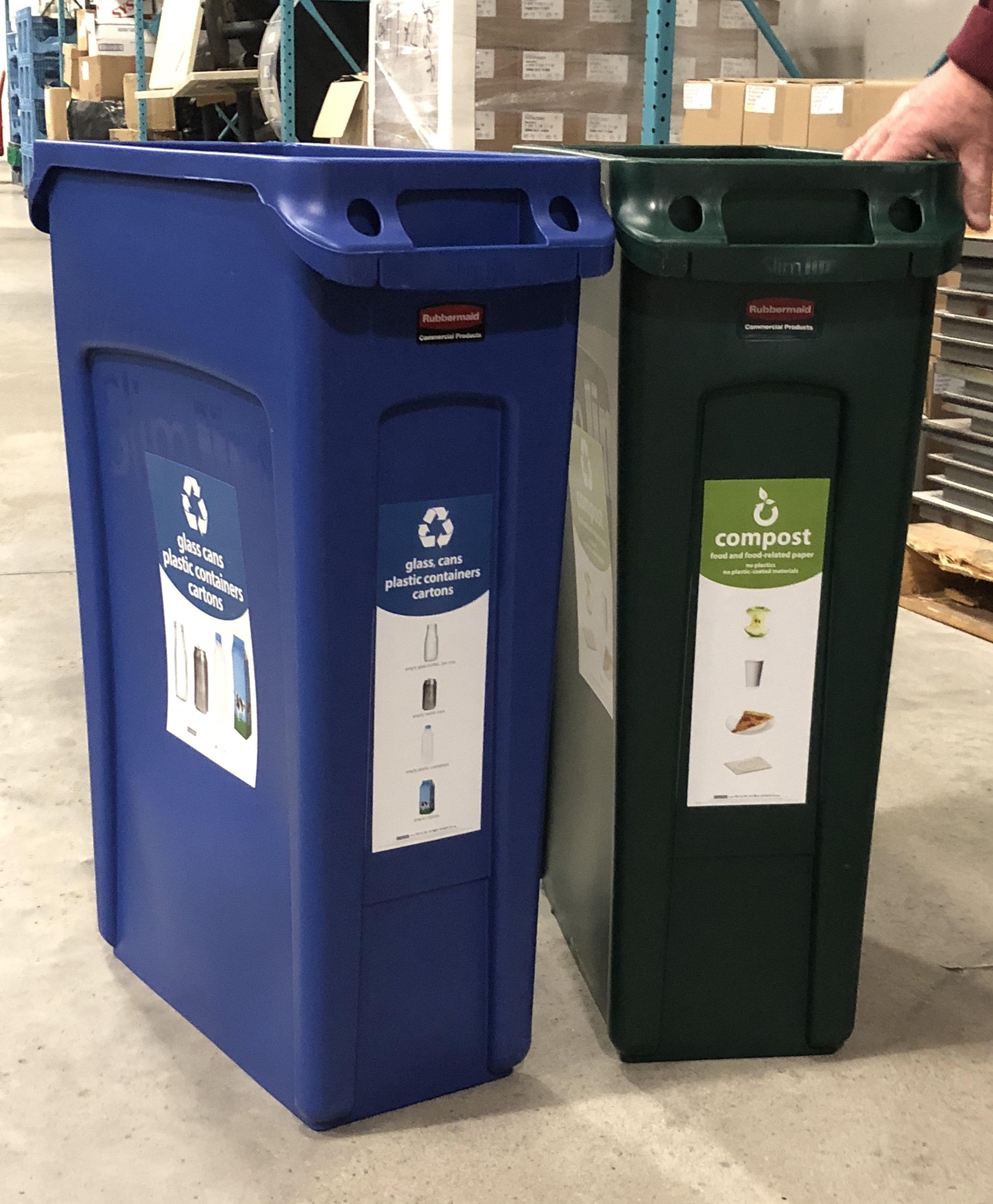
Example of Recycle Across America's standardized signage in use. These signs are used at U.S. Bank Stadium, MSP Airport, the MN State Fair, throughout the National Park System and countless other locations across the country. If you fly from Orlando to JFK in New York, you'll see the same signs on the bins, which will help you #RecycleRight
Recycling Bin Rental Program
Need Event Recycling? Check out the Minnesota Recycling Bin Program!
There is a program available to help maximize your recycling collection at events throughout the State through the rental of additional recycling containers for your venue or event. This service is supported by the Minnesota Beverage Association and their bottling members, to help increase recycling rates throughout Minnesota. Bins are available from as few as 20, up to 250, and boast the Recycle Across America standardized signage. Partner up to help enhance your program’s recycling goals!
Get a customized quote here.

Wish-Cycling
Wish-Cycling is the desire to recycle everything possible, even if it's not actually recyclable. The Minneapolis Star Tribune just had an article on these lofty recycling behaviors. See more HERE.
One of the challenges of this industry is that often MRF's (Materials Recovery Facility) accept different materials. And that even though some things are recyclable - say plastic bags - it doesn't mean it can go to the same facility.
Plastic bags are a great example. They are 100% percent recyclable. However... they totally mess up sorting machines. Eureka Recycling in Minneapolis has stated that they spend hours, HOURS, everyday, with the MRF machines down, picking bags out of the system.
So. Thank you. Thank you for wanting to do the right thing. For hoping that all of your materials end up as new items to be used again and again. But the best line of defense...
When in doubt, throw it out!